
Can You Render a House in Winter?
Cold weather does not always prevent external rendering work. Can you render a house in winter? Yes, but the air and wall temperatures, condition of the surface and forecast all need checking before work begins. K Rend, Weber, Parex and Licata set a minimum application temperature of 5°C for the products covered here. The wall must not be frozen or saturated, and fresh render needs protection against rain and frost while it cures. Lime render is more sensitive to cold and usually needs a warmer weather window.
Based in Brighton, our family-run team has over 20 years of experience applying traditional and through-coloured renders across the South East and London.
What temperature is too cold for render?
For the products discussed here, 5°C is the lowest application temperature published by the manufacturers.
Weber states that render should not be applied below 5°C. It also advises checking the temperatures during the previous day and night, rather than relying only on the temperature when work is due to begin.
K Rend gives its cementitious products a working range of 5°C to 35°C. Parex says the temperature should be 5°C and rising before its Monorex GF render is applied. Licata gives an application range of 5°C to 30°C for its silicone render.
This is why the answer to “Can you render a house in winter?” depends on the conditions before, during and after application, rather than the month alone.
Why does the wall temperature matter?
Even when the air has reached 5°C, the wall may still be too cold. Weber points out that if temperatures were below zero a few hours earlier, the substrate could still be frozen.
K Rend and Parex both state that render must not be applied to a frozen surface. A wall saturated by winter rain can also cause problems. K Rend warns that a wet substrate can affect adhesion and bonding, while a saturated wall that appears dry on the surface can contribute to lime bloom.
Weber also explains that an elevation allowed to become saturated is at greater risk of movement caused by drying shrinkage.
The following day’s forecast matters too. The guidance for weberpral M says it should not be applied if frost is forecast within 24 hours. K Rend’s application instructions also advise stopping work early enough for the render to set before frost arrives.
What can rain and frost do to fresh render?
K Rend advises protecting newly applied render from rain and frost for at least 48 hours while it cures. Drying can take longer in colder conditions, and rain during application can cause lime bloom, particularly on deeper colours.
Weber explains that damp conditions and low temperatures during early curing can also lead to lime bloom. This leaves a white film on the surface. Rain during application or shortly afterwards can affect the colour, texture and adhesion of the finish.
Thin-coat products have another risk. Weber’s synthetic top-coat renders rely on evaporation to set. When low temperatures slow this process, the coating can remain vulnerable to being washed off by rain.
How is fresh render protected in cold weather?
In frosty conditions, Weber advises that work should only continue when the scaffolding is enclosed and the temperature is raised with heaters. Tarpaulins, close-mesh netting and polythene can all be used to enclose scaffolding and protect the working elevation.
Water running down the building also needs to be controlled. K Rend’s application instructions state that downpipes, sills, copings and scaffold boards should not direct water onto render while it is setting.

The photograph above shows the scaffold during our external rendering of Brighton Orthodox Church. The work included re-running mouldings in situ and re-rendering areas to match the original building.
Are there renders made for colder conditions?
Some products can shorten setting or drying times in cooler conditions, but they do not remove the 5°C minimum or the need for winter protection.
K Rend Accelerator is a liquid additive that reduces the waiting time before scraped-texture renders can be scraped. It can be used at a minimum temperature of 5°C, but K Rend confirms that its usual winter precautions still apply.
K Rend also recommends Mineral TC for winter working because it dries more quickly at lower temperatures and in higher humidity.
Weber’s monocouche accelerator speeds up the initial set. At 5°C, it can give the same scrape time as standard monocouche render at 20°C. Weber explains that this leaves the render less susceptible to lime bloom.
Is lime render different in winter?
Lime takes longer to cure and can remain vulnerable to frost for much longer than modern cementitious render. We replicate traditional renders, including lime-based systems, so the weather and protection available are important considerations on older buildings.
Lime supplier Tŷ-Mawr advises applying its products only when temperatures are between 10°C and 25°C. It also says lime work should be kept damp for at least seven days after application. Where adequate protection cannot be provided, non-hydraulic lime and weaker natural hydraulic lime products may need to wait until spring.
Rose of Jericho recommends avoiding external lime putty mortar work between October and March. While moisture remains in the mortar, it can be vulnerable to frost for weeks or even months.
Planning a rendering job during colder weather
The practical answer to “Can you render a house in winter?” depends on the product specification, wall temperature, overnight forecast and protection available on site. The forecast during the curing period is just as important as the conditions when the render is applied.
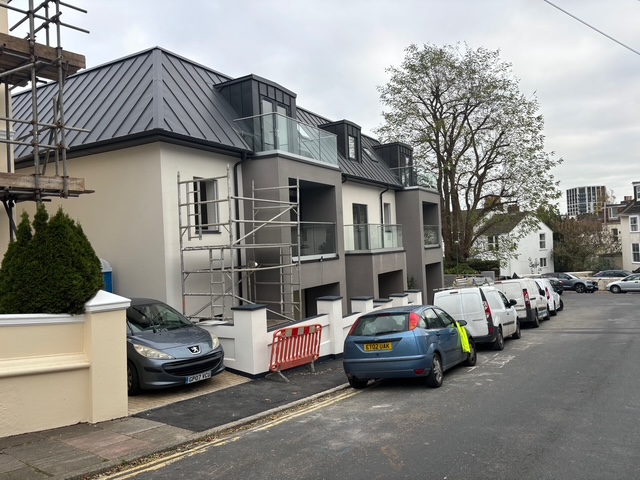
On larger projects, temperature and humidity can also affect the consistency of the finished colour. Our Central Brighton rendering project covered eight flats and two retail units. Access restrictions meant the work had to be completed in three phases across changing seasonal conditions.
Silicone render can show slight colour variations when temperature and humidity change. We worked with the main contractor to prepare a detailed construction programme and maintain a consistent colour across all three phases.
If you are still choosing a finish, our comparison of which type of house render is best covers the main options. Before arranging the work, it is also worth checking whether you need planning permission to render your house.
Talk to Fullers Plastering about rendering your house
Can you render a house in winter? It can be done when the air and wall temperatures meet the manufacturer’s requirements, the forecast allows enough curing time and suitable protection is available.
Fullers Plastering started as a specialist external rendering company and has over 20 years of experience. We are approved by K Rend, Weber, Parex, Licata and Greutol for through-coloured rendering, with 40 tradesmen working across the South East of England and London.
To discuss rendering your property, call 01273 686 368, email info@fullers-plastering.co.uk or contact us online.