
Which Type of House Render Is Best for Your Home
Working out which type of house render is best for your home usually comes down to four things: the age of the property, the climate it sits in, how much maintenance you want to take on, and your budget. For most modern UK homes, silicone render is the strongest all-rounder because it’s flexible, breathable and self-cleaning. For period and listed properties, lime render is almost always the right answer. Cement, monocouche and acrylic renders all have their place too, and the right choice depends on the building in front of you.
This guide walks through the main render types we work with at Fullers, what each one does well, and where each one falls short.
What render actually does
Render is the protective and decorative coating on the outside of a building. A good render system keeps water out, lets moisture from inside the wall escape, and gives the property a finish that lasts years without needing to be redone. A bad or wrongly-specified render can trap damp, crack within a season or two, and damage the brickwork underneath.
That’s why working out which type of house render is best for your home matters more than people realise. The wrong choice is not just a cosmetic problem.

The main types of render used in the UK
Silicone render
Silicone render is a thin-coat, polymer-based render applied over a reinforced base coat. It’s water-repellent thanks to silicone additives, but unlike some plastic-based finishes it stays breathable, so the wall behind it can still let moisture out. That makes it well-suited to modern homes, new builds, and any property exposed to wind and driving rain (so most of the South East, frankly).
It’s one of the more expensive options up front, and it needs experienced tradespeople and dry conditions to apply properly. The trade-off is a lifespan of 20 to 25 years before a refresh is needed, and it comes in a very wide range of colours and textures.
Monocouche render
Monocouche is French for “single layer.” It’s a cement-based, through-coloured render applied in one thick coat, then scraped to create the finished texture. Because the colour runs through the whole material, you don’t need to paint it.
It’s a popular choice on new builds where speed of application matters, and on solid-walled homes where the owner wants a low-maintenance, scratched finish. It’s less flexible than silicone, so more prone to hairline cracks if the building moves. The colour palette is more restricted, and it can absorb dirt and algae more readily on shaded elevations. It also has to be applied above 5°C and in dry weather, which shortens the working season in the UK.
Acrylic render
Acrylic render uses acrylic polymer resins blended with fine aggregates. It’s flexible, sticks well to most substrates, and dries quickly, which makes it a common choice for external wall insulation systems and homeowners wanting a wide colour range on a tighter budget than silicone.
The main thing to be aware of is that it’s less breathable than silicone or lime. That rules it out for most older solid-wall properties, where trapped moisture can do real damage. On a modern property with good ventilation, though, it’s a solid option.
Traditional sand and cement render
The old-school option. A mix of sand, cement, lime and water, applied in two coats and either left as-is, painted, or finished with pebbledash. It’s the most affordable choice and still earns its place on garden walls, outbuildings, and properties where the look needs to match neighbouring buildings.
The trade-off is rigidity. Sand and cement render is more prone to cracking as the building expands and contracts, and it’s porous unless painted with a good masonry paint. Cheaper to install, but it usually needs more upkeep down the line.
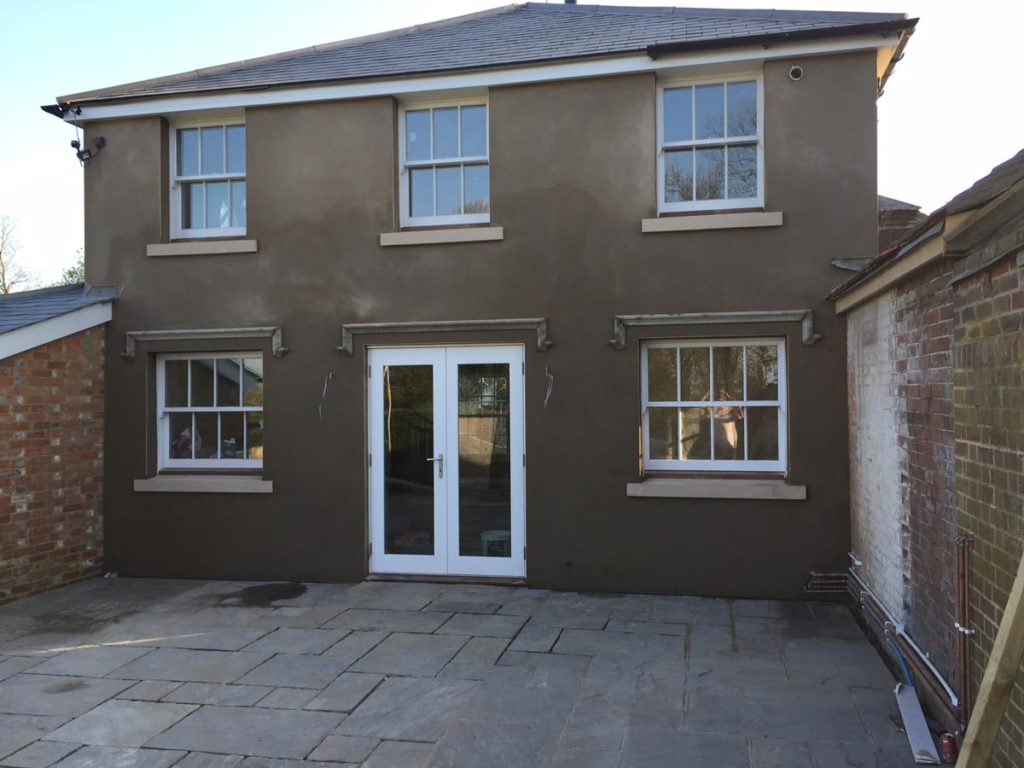
Lime render
Lime render has been used on UK buildings for centuries. It’s made from lime putty or hydraulic lime, sand and water, and the reason it keeps coming up is breathability. Older solid-wall buildings need to let moisture out, and lime is one of the only renders that allows them to do so. Cement-based renders trap damp, which is why you’ll often see them blamed for ruining period homes.
For listed buildings, conservation areas, and pre-1919 cottages, lime is usually the only render type you’re allowed to use. It needs skilled application because it behaves quite differently from modern cement-based products, and it’s less weather-resistant than thin-coat systems. But on the right building, nothing else will do the job properly.
So, which type of house render is best for your home?
There’s no single answer that applies to every house, but the honest version goes something like this. If you’ve got a modern detached, semi or new build, silicone is usually the best long-term value. If it’s a listed building or a pre-1919 solid-wall property, lime is the only sensible answer, anything else risks trapping damp and causing real damage. For external wall insulation, silicone or acrylic depending on budget. For garden walls, outbuildings, or matching an existing render, traditional sand and cement is fine. And for new builds where speed matters and the budget is tight, monocouche is a reasonable middle ground.
The other thing worth saying: which type of house render is best for your home also depends on who’s applying it. A premium silicone system installed badly will fail faster than a sand-and-cement render done by an experienced renderer. Materials matter, but workmanship matters more.
What about coastal properties
Brighton, Eastbourne, the rest of the Sussex coast, salt-laden air, driving rain off the Channel, and a lot of wind. Coastal homes put a render system through more in five years than an inland property sees in twenty.
For coastal properties we usually steer clients towards silicone render or a traditional rendering system with the right protective top coat. The breathability and water-repellency matter more here than on a sheltered inland site.

How we approach it at Fullers
We’ve been rendering homes across the South East and London for over 20 years, and we’re INCA-accredited for external wall insulation. That accreditation matters because it means an independent body has assessed our work, it’s not something you can buy.
When a client asks us which render to use, we look at the substrate, the exposure, the age of the property, planning constraints (especially for listed and conservation work), and what they want it to look like in ten years’ time. The right answer is rarely the one that looked best in the brochure.
A few common questions
How long does render last? Silicone render typically lasts 20 to 25 years before needing a refresh. Monocouche and acrylic have similar lifespans when applied well. Sand and cement tends to need more attention sooner, particularly in exposed locations. Lime render on a well-maintained period property can last decades.
Can I render over existing render? Sometimes, but only if the existing render is sound, well-bonded and the right type. We’d always assess this on site rather than guess.
Does render need painting? Through-coloured renders like silicone, monocouche and some acrylics don’t. Sand and cement render does, usually with a breathable masonry paint.
Does render improve insulation? Render alone gives a small thermal benefit. If insulation is the real goal, you want an external wall insulation system with a render finish on top.
Which Type of House Render is Best for Your Home?
The honest answer to which type of house render is best for your home is that it depends on the building, the climate, and what you want from it. For most modern UK homes, silicone render gives the best long-term performance. For period properties, lime is the only sensible choice. For tighter budgets and simpler jobs, traditional cement-based renders still earn their place.
If you’d like a straight answer for your specific property, get in touch and we’ll come and look at it. We’re a family-run firm based in Brighton with 40 tradesmen working across Sussex, the South East and London, and we’d rather give you the right recommendation than the most expensive one.